

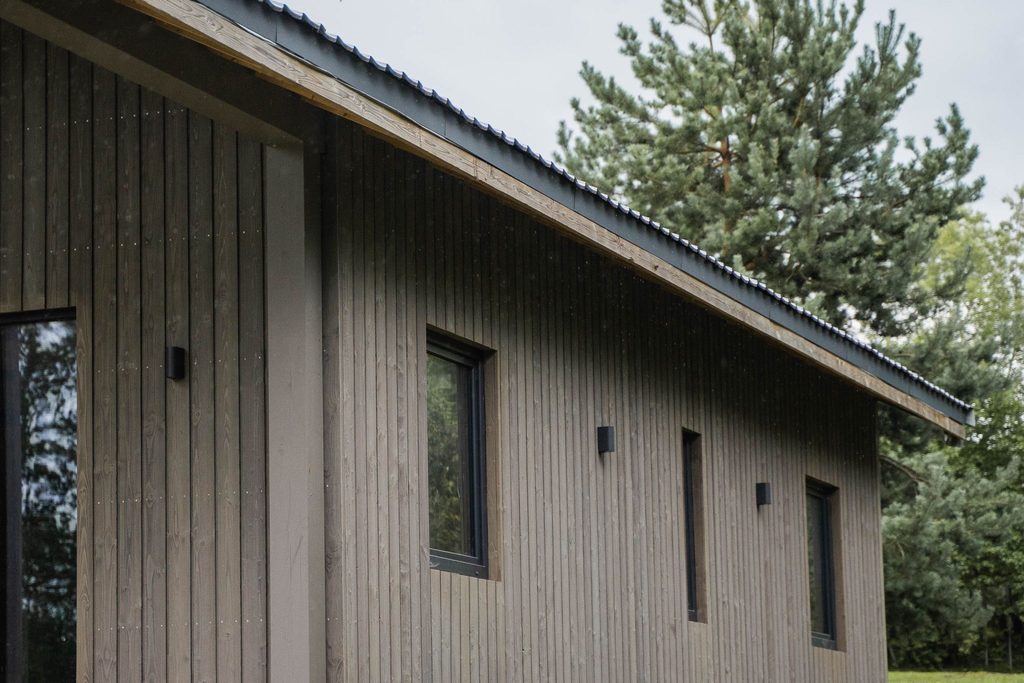
Shou Sugi Ban is a traditional Japanese technique of charring wood that is appearing more and more often in contemporary architecture. Fire transforms the surface of the board, brings out its texture and creates a distinctive effect: from deep black to natural browns and a strongly accentuated grain.
Charred wood is used mainly on façades, but also on terraces, fences and in interiors. What exactly is Shou Sugi Ban and why has this technique become so popular?
What is Shou Sugi Ban?
Shou Sugi Ban is the name used outside Japan for the traditional method of surface charring of wood. In Japan, the term yakisugi is more commonly used. “Yaki” refers to charring, while “sugi” means Japanese cedar (Cryptomeria), the wood species traditionally used in this technique.
The process involves the controlled action of fire on the surface of the board. Depending on the desired effect, the charred layer can be kept or partially removed by brushing. As a result, the wood can look very different: from an intensely black surface to warm, natural shades with a strongly emphasised grain pattern.
Where does the yakisugi wood charring technique come from?
Yakisugi originates from Japan and was originally used mainly to prepare timber cladding for buildings. In the traditional method, three boards were arranged to form a vertical, triangular chimney. A fire was lit inside it, charring the surface of the wood. Once the right effect had been achieved, the boards were separated and cooled.
Today, torches and more controlled production processes are also used, making it easier to achieve a specific degree of charring and a consistent visual effect.
What does the process of charring wood for façades look like?
The process may vary depending on the wood species and the desired effect, but it usually involves several stages.
Selecting the wood
Each species reacts differently to high temperatures. Differences in structure, density and grain affect the appearance of the finished board.
Our Dragonwood range includes various wood species, including larch, spruce, oak, Douglas fir and thermo pine.
Charring the surface
The wood is subjected to the controlled action of fire. The aim is not to burn the board, but to transform its outer layer in the right way. The more intense the charring, the darker and more striking the surface can be.
Brushing
Depending on the desired look, the charred layer can be partially removed. Brushing reveals the structure of the wood and further accentuates the natural grain pattern.
Finishing
The final stage may be an additional surface finish that affects the colour and appearance of the finished board.
Does Shou Sugi Ban always mean black wood?
No. A black, heavily charred surface is the most recognisable effect of Shou Sugi Ban, but the possibilities are much broader. Depending on the wood species, the degree of charring, brushing and subsequent finishing, you can achieve shades of black, graphite, anthracite and brown, as well as colours close to natural wood.
The Dragonwood collection is available in various finishes, so the wood can be matched to the colour of the windows and doors, roof, render or stone. See the Dragonwood collection
Why does charred wood look so distinctive?
With conventional painting, colour is applied to the surface of the board. When wood is charred, fire acts directly on its structure. As a result, the grain, natural colour variations and texture of the material remain visible. Individual boards may differ slightly from one another, which is a natural characteristic of wood.
It is this effect that makes charred wood work so well with modern architecture and with materials such as glass, steel, stone and concrete.
Where can charred wood be used?
The most characteristic application is charred wood for façades. It suits both minimalist buildings and modern barn-style houses, as well as timber-frame and modular structures. Charred wood also works well on:
- terraces
- fences
- decorative walls
- interior elements
- selected sections of the façade
It can be the main finishing material or simply an accent highlighting a specific part of the building’s form. We write more about practical applications in our article on Dragonwood charred timber for façades, terraces and fences.
How to choose charred wood for a façade?
When choosing, it is worth paying attention to more than just the colour. The wood species, degree of charring, surface texture, type of finish, board profile and installation method also matter.
Wood is a natural material, so its appearance can also change depending on the light. The same colour may look different in full sun, in the shade and under a wide eave. That is why it is worth seeing a real sample of the material before making a decision.
Dragonwood – charred wood with a modern twist
Dragonwood combines inspiration from the traditional wood charring technique with a contemporary approach to façade and interior design. Different wood species and finishes make it possible to achieve both a bold, dark effect and calmer, more natural surfaces.
See Dragonwood in person
If you are planning a façade, terrace or another element made of charred wood, it is worth seeing the material away from the screen. You can also find inspiration in our charred wood projects. Explore Dragonwood charred timber in the Azzura Group range and order a free sample!
