

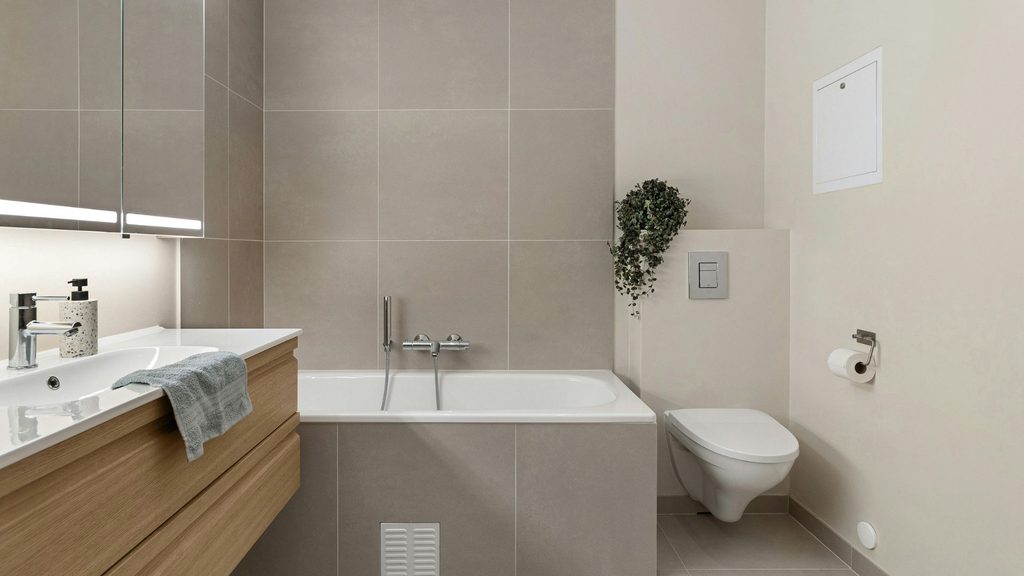
A concealed WC frame, a bathtub and pipes can be hidden behind attractive boxing finished with tiles. In a bathroom, however, it is not only the look that counts. The material should cope well with increased humidity, form a stable substrate for cladding and allow access panels to be installed. So what should you use to box in a WC frame, bathtub and pipework so that the result is durable and safe?
What should you use to box in a concealed WC frame?
A WC frame is most often enclosed with boards fixed to a prepared framework. It is the frame itself that carries the weight of the pan and the user. The board’s job is to close off the structure and create a flat, stable substrate for tiles.
The material used for boxing in should be resistant to bathroom conditions and sufficiently rigid. It is also important to be able to cut precise openings for the flush button, waste pipe and connections. The number of board layers, stud spacing and fixing method should be selected in accordance with the instructions of the WC frame manufacturer and the entire boxing system, which is particularly important if the surface is to be finished with heavy or large-format ceramic tiles.
Which material should you choose for bathroom boxing?
The options include standard plasterboard, moisture-resistant plasterboard, cement boards and specialist gypsum boards intended for areas exposed to moisture. Each of these solutions has different properties, so it is not worth basing your choice solely on the price of the board.
Standard plasterboard is intended mainly for dry interiors, so it should not be your first choice for bathroom boxing. Green moisture-resistant board copes better with increased humidity, but around a bathtub, WC frame or pipes it is worth considering a material designed for more demanding conditions.
A good solution between these options is the BoardeX board from our range – it has a reinforced core and a glass-fibre mat. It combines increased moisture resistance with processing similar to that of gypsum boards. As a result, it can provide a stable substrate for tiles, while making it easier to cut openings for the flush button, connections or an access panel than in a heavier cement board. For WC frames, bathtubs and pipework, it is therefore a practical choice for anyone who expects greater safety than standard plasterboard offers, but does not want to make installation harder. The board alone, however, does not replace correctly executed waterproofing.
What should you use to box in a bathtub?
A bath panel is regularly exposed to splashing. Water can get in through a leaky grout line, a corner or the joint between the bathtub and the wall, so the structure should be made of a material intended for damp rooms.
A board gives you a lot of freedom in shaping the panel and allows you to achieve a flat surface for tiles. In this application, BoardeX meets the practical needs of installers well: it is designed for conditions of increased humidity and can also be easily adapted to the shape of the boxing. During installation, however, access to the trap and pipe connections must be maintained. The access opening should be large enough to allow repairs without destroying the entire boxing in the event of a failure.
Before the tiles are laid, the surface must be protected in accordance with the design and the recommendations of the waterproofing system. Corners, junctions between materials and pipe penetrations require particular attention. The same rules apply in the shower area, where the walls are in constant contact with water – we discuss choosing the right substrate there in our article on which board for tiles in a shower enclosure works best.
What should you use to box in pipes and risers in the bathroom?
Water pipes, drains and soil stacks are usually concealed within a lightweight structure of studs and boards. Such boxing improves the look of the interior, but must not make it harder to access components that need inspection.
Valves, water meters, filters and service connections should remain accessible through access hatches. For soil stacks, it is also worth considering suitable acoustic insulation to reduce the sound of flowing water.
When boxing in pipework, ease of processing is particularly important. In a small bathroom, you often need to cut narrow pieces and make several openings. This is another argument for choosing a board that combines moisture resistance with easy processing, such as BoardeX. It allows you to use a single material for the WC frame, the bath panel and the pipe boxing, without reaching for a heavier cement board everywhere. We describe the parameters and applications of this board in more detail in our guide to the BoardeX board.
Is a moisture-resistant board enough?
Even a material with increased moisture resistance should not be treated as stand-alone protection against water. Areas exposed to splashing require a complete system of layers: a stable structure, a suitable board, correctly finished joints (e.g. with a moisture-resistant compound such as Handycoat Washable), under-tile waterproofing, sealing tapes and collars, and an adhesive suited to the type of cladding.
Before the boxing is closed, the pipework should also be checked for leaks. Fixing a fault later may require removing tiles and part of the structure.
The most common mistakes when boxing in a WC frame, bathtub and pipes
Problems most often stem not from the type of board itself, but from installation errors. These include:
- a framework that is too flexible to carry tiles,
- no support for board edges,
- omitting waterproofing in areas exposed to water,
- no access to valves, the trap or water meters,
- improper sealing of corners and pipe penetrations,
- choosing the number of layers without taking into account the WC frame manufacturer’s recommendations,
- failing to account for the weight of the planned tiles.
Which board should you choose for bathroom boxing?
For boxing in a WC frame, bathtub and pipework, it is worth choosing a material intended for rooms with increased humidity, stable under tiles and easy to work with. A heavy cement board is not always necessary, while standard board for dry interiors may prove insufficient. That is why BoardeX is a choice worth considering: it offers a favourable combination of resistance, stability and ease of installation, especially when one board is to be used for several types of boxing in the bathroom.
This does not mean that choosing the board solves all installation issues. The best results come from treating the boxing as a complete system. Its durability also depends on the rigidity of the framework, the quality of fixing, the waterproofing and careful execution of all joints. When renovating a whole bathroom, it is also worth planning the floor at the same time, especially if it is to include underfloor heating. This decision determines the floor build-up, and in lightweight construction you can consider a dry system such as Azzura ThermoFloor.
