

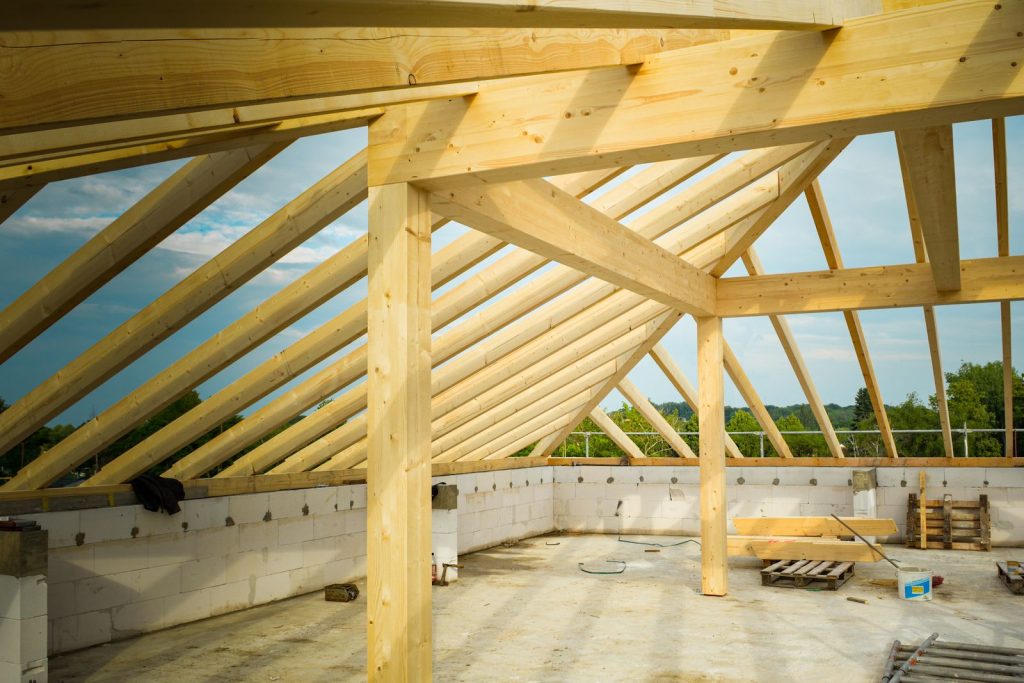
What to use instead of OSB board on a roof when we need greater moisture resistance, fire resistance and longer service life of the partition? This question is increasingly appearing in projects for houses, commercial buildings, warehouses and light steel structures. OSB still has its applications, but it won’t be the best choice for every roof. In many projects, modern roof boards with higher material resistance perform better.
What to use instead of OSB board on a roof? A short answer to start
OSB board can be replaced with a modern roof board designed to work under roof covering. A good example is BoardeX Roof, a board with fire reaction class A1, low water absorption and high resistance to mould growth.
When choosing an OSB substitute, it is worth checking primarily:
- material’s moisture resistance,
- fire reaction class,
- dimensional stability,
- mould resistance,
- mechanical strength,
- board’s intended use in manufacturer’s documentation,
- compliance with roof design and layer arrangement.
It’s not just about finding a board with a similar format. Roof sheathing is part of a partition that will be exposed to temperature changes, periodic moisture, loads and structural movement for years. Therefore, the choice of material should result from the conditions of a specific project, not just from habit with familiar solutions.
Why is OSB board on a roof not always sufficient?
OSB board is popular, readily available and well known to construction crews. It is used in many structural works because it can be quickly processed and installed. Its limitations become visible where the roof must meet higher requirements for moisture, fire or durability of the entire system.
The most commonly analysed weak points of OSB are:
- susceptibility of wood-based materials to moisture,
- risk of swelling with prolonged contact with moisture,
- possibility of surface deformation,
- limitations related to fire reaction,
- need for rapid protection of the board after installation,
- high dependence of durability on correct execution of ventilation and roof layers.
The roof is one of the more demanding parts of a building. Sheathing may be exposed to rain or elevated moisture even before laying subsequent layers. A delay in works, weather change or technological break is enough for the material to remain in more difficult conditions than assumed on paper.
In the case of OSB, the selection of the appropriate board class, edge protection and quick closure of the partition are very important. For projects where the margin of error should be smaller, a natural question arises: what to use instead of OSB board on a roof to reduce the risk associated with moisture, fire and sheathing durability?
What parameters should a roof board have instead of OSB?
An OSB substitute should correspond to the function that the board performs in the roof. The material cannot be evaluated solely through the prism of price or installation convenience. What counts is its behaviour in the entire system: under the covering, at variable temperature, with periodic moisture and under load.
Moisture Resistance
Moisture is one of the main reasons why investors and designers seek alternatives to OSB. A good roof board should have limited water absorption and a stable core. This reduces the risk of swelling, edge weakening and dimensional changes.
Before selecting a material, it is worth checking:
- total water absorption,
- surface absorption,
- board behavior under periodic moisture exposure,
- manufacturer’s installation recommendations,
- permissible exposure time to construction site conditions.
Moisture resistance does not replace proper roof execution. Appropriate layers, sealing, ventilation and compliance with design are still required. However, a material with low absorbency provides greater safety when weather or work schedule does not go ideally.
Fire Reaction Class
The second important parameter is the material’s reaction to fire. In residential, commercial and industrial construction, not only the load-bearing capacity of the structure is increasingly checked, but also the share of combustible materials in partitions.
When selecting a roof board, attention should be paid to:
- fire reaction class,
- possibility of using the material in buildings with increased requirements,
- board’s impact on the design of the entire roof system,
- manufacturer’s technical documentation.
Class A1 indicates non-combustible material. This is particularly important for large-area roofs, lightweight steel structures, halls, commercial buildings and buildings where fire safety must be treated with special care.
Mold Resistance
Mold in roof layers usually does not appear accidentally. It is favored by moisture, limited ventilation and material susceptible to microorganism growth. The problem can be difficult to notice because it develops under the roofing, often without quick symptoms visible from the user’s side.
A mold-resistant roof board reduces the risk of material degradation under elevated moisture conditions. This is important for the durability of the sheathing, technical quality of the partition and safety of the entire investment.
Mechanical Strength
Roof sheathing must transfer loads resulting from installation, use and structural performance. The material should maintain a stable surface, adequate stiffness and resistance to damage.
When evaluating strength, it is worth considering:
- bending resistance,
- surface stability,
- board weight,
- fastening method,
- compatibility with planned roofing,
- possibility of application in a given type of structure.
BoardeX Roof as an Alternative to Traditional OSB Board
BoardeX Roof is a modern roof board intended for use as underlayment for roof coverings. It was developed with roofs and lightweight structures in mind, where resistance to moisture, fire and mold are significant.
According to Azzura Group data, BoardeX Roof is distinguished by parameters that address the most common limitations of traditional wood-based panels:
- fire reaction class A1,
- core with low water absorption coefficient,
- total water absorption up to 5 percent,
- surface absorption up to 100 g/m²,
- mould resistance determined according to ASTM D 3273,
- reinforcement on the underside with fibreglass mat,
- format 1830 x 1200 mm,
- thickness 15 mm,
- average weight 13.5 kg/m².
BoardeX Roof should not be perceived as a simple board to replace OSB. It is a material with a different technical profile. It performs well where the roof requires greater moisture resistance, higher fire safety class and stability over a longer service life.
Where can BoardeX Roof be used?
BoardeX Roof is primarily intended as a substrate for roof coverings. However, its application may be broader, depending on the design and technical recommendations.
The material can be considered for:
- roofs in residential buildings,
- commercial facilities,
- industrial facilities,
- lightweight steel structures,
- selected wall solutions,
- projects where non-combustible materials are required,
- projects exposed to elevated humidity.
For the designer and contractor, it is important that one material can meet several technical requirements at once. In larger projects, this facilitates planning, logistics and quality control.
How does BoardeX Roof board differ from OSB?
The difference between OSB and BoardeX Roof results from the material’s structure and its properties. OSB is a wood-based board. BoardeX Roof has a low-absorption core and fibreglass mat reinforcement, plus fire reaction class A1.
Material comparison
When selecting a board, it is worth comparing several areas:
- fire resistance,
- reaction to moisture,
- mould resistance,
- dimensional stability,
- designation in technical documentation,
- application in lightweight structures,
- installation requirements.
OSB can be a good material in many applications, but in roofs with higher requirements its properties are sometimes insufficient. BoardeX Roof better responds to situations where the design assumes non-combustible sheathing, limited water absorption and greater resistance to mould growth.
When is it worth analysing the differences between OSB and BoardeX Roof
The differences between OSB and BoardeX Roof are worth analysing particularly when:
- the roof has a large area,
- the building has elevated fire requirements,
- the sheathing may be periodically exposed to moisture,
- the project involves lightweight steel construction,
- the priority is to reduce the risk of mould,
- the design requires a material with repeatable parameters,
- the investor assumes a long period of trouble-free operation.
In such projects, the question of what to replace OSB board with on the roof concerns not only the choice of board. It concerns the quality of the entire building element.
Moisture-Resistant Roof Board – Why This Parameter Is So Important?
Moisture can appear in the roof at several stages. First during construction, when the sheathing is already installed, but subsequent layers have not yet been laid. Later during use, when the roof reacts to temperature differences, water vapor, possible leaks or improper ventilation.
Moisture penetration of the sheathing material can lead to:
- board swelling,
- surface deformation,
- edge weakening,
- loss of stiffness,
- deterioration of interaction with the roof covering,
- creation of conditions conducive to mold.
A moisture-resistant roof board is therefore important not only in industrial buildings. In residential construction, it also helps reduce the risk of repairs, which after completion of the investment can be costly and difficult to carry out.
Does Moisture Resistance Mean No Need to Protect the Roof?
No. Even the best board requires proper installation. It is necessary to ensure tightness, ventilation, membranes, flashings and compliance with the design.
Moisture resistance means, however, that the material better withstands situations typical for construction. When works are prolonged or weather conditions are less favorable, a board with low water absorption provides a greater safety margin than a material more susceptible to moisture.
Non-Combustible Roof Board in Modern Construction
Fire safety does not only concern large halls or public buildings. It is increasingly being analyzed also for single-family houses, modular construction, service pavilions and light steel structures.
A roof board with fire reaction class A1 can be significant for:
- commercial buildings,
- halls,
- industrial buildings,
- public buildings,
- light steel structures,
- large-area roofs,
- investments designed with limitation of combustible materials.
It should be remembered that the fire reaction class of a single material does not describe the fire resistance of the entire roof. The partition should be assessed as a complete system of layers. Nevertheless, the selection of a non-combustible roof board can be an important element of a safer design.
When Is It Worth Choosing a Roof Board Instead of OSB?
Not every investment requires abandoning OSB. There are projects in which this material can be used in accordance with technical assumptions. However, it is worth considering a modern roof board when the roof is to meet higher requirements.
A roof board instead of OSB will be a good choice when:
- the design requires higher fire resistance of materials,
- the sheathing may come into contact with periodic moisture,
- the investor wants to reduce the risk of mould development,
- the structure is based on a lightweight steel frame,
- the roof has a large surface area,
- material stability over many years is important,
- the documentation requires materials with specific parameters.
At this point, it is worth returning to the question: what to replace OSB board with on the roof if the investor expects a more durable solution? The safest direction is to choose a board designed with roofing conditions in mind, rather than a material selected solely based on availability.
How to select an OSB substitute for a specific roof?
The selection of roofing board should result from the design, type of structure and requirements of the entire partition. The material is selected differently for a single-family house, differently for a warehouse, service pavilion or steel structure.
What to check before selecting a board?
Before making a decision, it is worth analysing:
- type of structure,
- type of roof covering,
- anticipated loads,
- fire protection requirements,
- moisture conditions,
- ventilation method,
- manufacturer’s recommendations,
- compatibility of the board with remaining layers.
Such analysis protects against a simple mistake: replacing one material with another without checking how the entire roof will behave. Modern roofing board offers wide possibilities, but requires the same design care as other building elements.
When to consult the choice with a supplier or designer?
Consultation is particularly advisable when the roof has an unusual structure, large surface area, increased fire requirements or increased risk of moisture penetration. It is also worth using it for lightweight steel structures and commercial buildings.
Proper material selection should not end with price comparison. It is important to check whether a given board matches the design, covering, fastening method and expected roof durability.
Mistakes when selecting roofing board instead of OSB
Replacing OSB with modern roofing board can improve roof parameters, but only if the decision is made consciously. Most problems result from treating all boards as materials with the same function.
The most common mistakes are:
- selecting board based solely on price,
- omitting fire reaction class,
- lack of water absorption analysis,
- failing to consider mould resistance,
- omitting technical documentation,
- using material inconsistently with its intended purpose,
- lack of consultation on unusual designs,
- assessing board without reference to the entire roof system.
The roof is a partition whose repair after completion of investment is difficult and costly. Therefore, the sheathing material should be selected with long-term operation in mind, not solely for the installation stage.
Modern Roof Boards and Investment Costs
The price of a board matters, but it should not be the sole deciding factor when selecting a material. In the case of roofing, the cost of the entire solution over time carries more weight. A cheaper board may require greater care on the construction site, faster protection and more precise control of installation conditions.
When comparing costs, it is worth considering:
- material durability,
- moisture resistance,
- fire reaction class,
- mould resistance,
- risk of subsequent repairs,
- ease of work execution,
- the board’s impact on partition safety.
If the investor looks only at the purchase price, OSB may seem a simpler choice. When analysing durability, resistance and operational risk, a modern roof board may prove more justified.
What to Replace OSB Board with on a Roof? — Key Questions and Answers
What to replace OSB board with on a roof?
OSB board on a roof can be replaced with a modern roof board resistant to moisture, fire and mould. An example of such a material is BoardeX Roof, which can be used as an underlayment for roof coverings.
Is BoardeX Roof suitable as an OSB replacement?
Yes, BoardeX Roof can be considered as an alternative to OSB in roofing applications. The material has fire reaction class A1, low water absorption and mould resistance, making it suitable where traditional wood-based boards may be insufficient.
Is OSB board on a roof a poor solution?
Not always. OSB is a material used in construction, but it requires proper selection, protection and installation. In projects with higher technical requirements, it is worth considering a board with better resistance to moisture, fire and mould.
What roof board instead of OSB will be best?
The best roof board instead of OSB is one that meets the conditions of a specific project. It is worth checking the fire reaction class, water absorption, mould resistance, mechanical strength and the material’s intended use.
Does a non-combustible roof board matter in a single-family house?
Yes, although it is most significant in buildings with elevated fire safety requirements. In a single-family house, a non-combustible roof board can raise the safety standard and reduce the share of combustible materials in the partition.
Can a moisture-resistant board be exposed to rain?
Moisture resistance does not mean that the material can be left unprotected for an indefinite period. Every roof board should be installed according to the manufacturer’s recommendations and covered with subsequent layers as quickly as possible. Limited water absorption, however, provides greater safety during typical construction conditions.
When is it worth choosing BoardeX Roof instead of OSB?
BoardeX Roof is worth considering when non-combustibility, moisture resistance, mould resistance and material stability are important. This is particularly significant in lightweight steel structures, commercial and industrial buildings, and roofs designed to a higher technical standard.
Does the choice of roof board affect the durability of the entire roof?
Yes. The sheathing is part of the roof system and affects the stability of subsequent layers. A properly selected roof board can reduce the risk of deformation, moisture damage and operational problems.
Does replacing OSB with another board require changing the design?
In many cases, the choice of a different board should be consulted with the designer or technical supplier. It is not only the material itself that matters, but also its interaction with the structure, roofing, insulation and other roof layers.
