

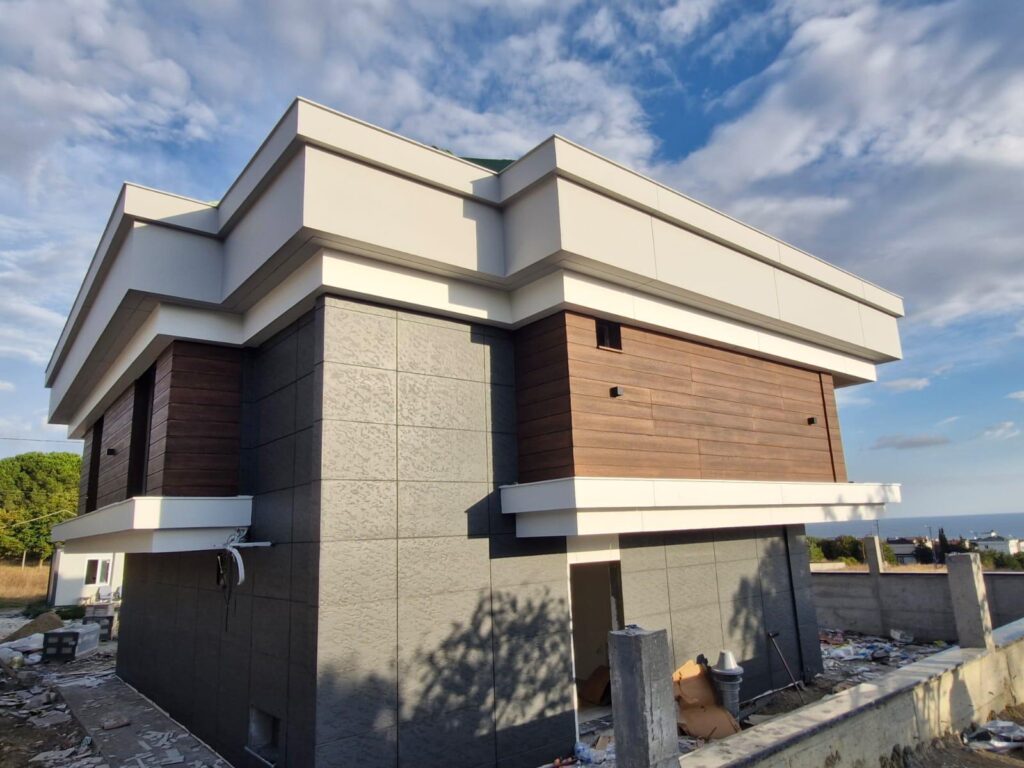
The choice of sheathing board has a direct impact on how a framed wall is built, how it behaves in increased humidity, its fire safety and the pace of subsequent work. OSB, cement boards, magnesium boards and specialist gypsum boards for external use look similar at the installation stage, but their properties and role in the wall assembly differ.
That is why the question “magnesium or cement board?” has no single right answer. First, you need to establish what you really expect from the sheathing: bracing of the structure, weather resistance, non-combustibility, dimensional stability, easy processing or several of these features at once.
In this comparison, we take a close look at four solutions: OSB, cement boards, MgO magnesium boards and BoardeX – our specialist gypsum board reinforced with glass fibre, intended, among other things, for external sheathing.
Sheathing board – a comparison has to start with function
In a framed structure, a board may be responsible for, among other things, closing off the outside of the wall, providing a substrate for subsequent façade layers, contributing to bracing the structure or delivering specific properties related to moisture and fire safety.
No board performs all of these functions at once.
- OSB is a widely used wood-based structural material, although it is used less and less in construction due to its numerous drawbacks,
- Cement boards are mineral materials intended, among other things, for external cladding and sheathing in conditions exposed to moisture. MgO magnesium boards are yet another group. Their properties can vary greatly depending on their composition and production technology, so they should not be judged solely by the name “magnesium board”.
- BoardeX, in turn, is a GM-F H1 R gypsum board with a reinforced core and glass-fibre surfaces. It was developed for applications such as external sheathing, façades and areas exposed to increased humidity.
OSB as sheathing – when does it have the advantage?
OSB is one of the most commonly used materials for sheathing timber structures. Its key advantage is that properly designed sheathing can be used as part of the structural performance of the wall.
This is particularly important when the board contributes to bracing the frame and transferring horizontal loads. This does not, of course, mean that any OSB board installed carelessly will provide the required bracing. Things get complicated when the board is also expected to offer high resistance to long-term moisture or non-combustibility.
OSB remains a wood-based material and reacts to changes in humidity, which is why its use is recommended less and less often.
When does OSB not make sense?
If non-combustibility, resistance to periodic moisture and external sheathing for a façade system are the top priorities, it is worth looking at other groups of materials as well.
Cement board as sheathing – resistance at the cost of greater weight?
Cement boards are the natural choice where sheathing has to perform in demanding external conditions. They are made of cement and reinforcement, for example glass-fibre mesh. Depending on the product, they can be resistant to water, weather and mould, and have a high reaction-to-fire class.
One example is the AQUAPANEL Outdoor cement board, intended for external walls and ceilings. The manufacturer states an A1 reaction-to-fire class and resistance to water and weather.
That does not mean, however, that every “cement board” has identical parameters. When designing, always refer to the documentation of the specific product, because weight also plays a major role.
For example, a 12.5 mm AQUAPANEL Outdoor board has a declared weight of approximately 16 kg/m², while BoardeX of the same thickness weighs approximately 10.8 kg/m². Over a large wall area, the difference in weight affects not only the structure, but also transport, manual handling of the boards and the organisation of work on site.
When does cement board make sense?
Especially in applications where very high resistance to water and weather is the priority and the greater weight of the material does not interfere with the design or installation.
Magnesium board for sheathing – what to watch out for?
Magnesium board for sheathing is sometimes offered as an alternative to cement, gypsum and wood-based boards. Here, however, particular caution is needed when comparing products solely on the basis of the “MgO” category.
Tests of various magnesium boards on the market have shown significant differences in behaviour at high humidity. In some products with magnesium chloride binders, moisture absorption and phenomena that can lead, among other things, to corrosion of adjacent metal elements were observed.
This does not mean that every MgO board behaves this way. More recent research indicates that properly formulated magnesium boards, including solutions based on other types of binder, can maintain significantly different stability under prolonged exposure to moisture.
The conclusion is simple: with MgO boards, the specific manufacturer’s documentation is particularly important.
So where does BoardeX fit into this comparison?
BoardeX needs to be discussed separately, because it is neither a cement board nor a magnesium board.
It is a gypsum board reinforced with a glass-fibre mat, classified as GM-F H1 R in accordance with EN 15283-1+A1. It was designed for external wall sheathing and other applications exposed to moisture.
This solution is of interest when a contractor needs sheathing that combines several features:
- suitability for external applications,
- increased resistance to moisture,
- A1 reaction-to-fire class,
- relatively low weight,
- dry installation technology,
- suitability for use in lightweight structures and façade systems.
In BoardeX, total water absorption is no more than 5%, and reaction to fire has been classified as A1. For a 12.5 mm board, the average weight is approximately 10.8 kg/m².
For teams working with timber-frame and LSF technology, the combination of moisture resistance and a lower weight than some mineral cement boards is particularly practical.
OSB, cement board, MgO or BoardeX – comparison table
| Criterion | BoardeX | Cement board | MgO magnesium board | OSB |
| Material type | Gypsum with glass-fibre mat | Mineral, cement-based | Mineral, based on magnesium compounds | Wood-based |
| Possible use as external sheathing | Yes | Yes, for boards intended for external applications | Depends on the specific product | Yes, with the right product and build-up |
| Possible structural function | Should not be assumed without system documentation and a design | Depends on the product/system | Depends on the product/system | Yes, in a properly designed build-up |
| Behaviour in moisture | H1, total water absorption ≤ 5% | Usually a strong point of boards for external applications | Strongly dependent on composition and manufacturer | Requires proper selection and protection |
| Reaction to fire | A1 | A1 solutions available | Depends on the specific product | Depends on the specific product |
| Weight | approx. 10.8 kg/m² at 12.5 mm | Often relatively high | Depends on the product | Depends on type and thickness |
| Importance of the specific product’s documentation | Very high | Very high | Particularly high | Very high |
| Typical selection criterion | Moisture + A1 + lightweight dry sheathing | High environmental resistance | Properties depend on the specific product’s technology | Structural function and sheathing |
The table is for comparison purposes only. The final choice of board should always be based on the material’s technical documentation and the design of the entire wall assembly.
Which sheathing board will work in a specific application?
If the structural function and bracing of the timber frame are the top priority, the natural starting point is a suitably selected structural board, including BoardeX.
If the priority is maximum resistance to water and harsh external conditions, it is worth analysing suitable cement boards.
If a magnesium board is being considered, the decision should be based not on the name of the material, but on the documentation of the specific product and its proven behaviour in the conditions specified in the design.
And if you are looking for lightweight, dry external sheathing with an A1 reaction-to-fire class and increased moisture resistance, BoardeX is one of the solutions worth considering.
This approach is more useful than searching for a single “best board” regardless of the application.
Do not compare board prices alone
An investor should look at more than just the price of the material per square metre.
The weight of the boards, the time needed for handling and processing, the tools required, the fixing system, the method of moisture protection, additional layers and the consequences for later stages of the project all count as well.
A material that is cheaper to buy does not always result in a cheaper complete wall. Equally, a more expensive board is not always technically justified.
In timber-frame construction, it is particularly important to look at the entire wall build-up and the construction process, rather than at a single product taken out of context.
Not sure which board is right for your project?
Send us information about the structure, the planned wall build-up and the type of façade. Azzura Group will help you choose a material that meets the real requirements of the project, rather than narrowing the choice down to the price of a single board.
Ask for an individual quote – delivery included.
