

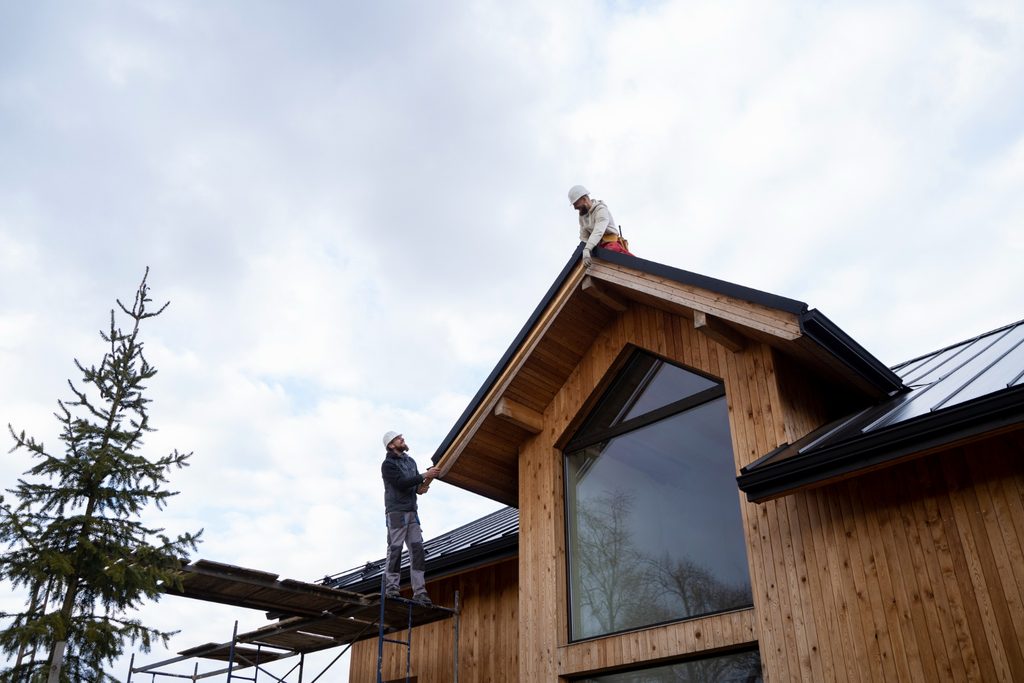
In a timber-frame house, wall sheathing is much more than simply “closing off” the structure. The same board can brace the frame, provide a substrate for subsequent façade layers, protect the building during construction and genuinely change the properties of the entire wall assembly. It all depends on the function assigned to it in the design.
The options available include P5 structural particleboards, fibre-reinforced cement and fibre cement boards, as well as specialist gypsum boards with a glass-fibre mat, such as BoardeX.
Why is a timber-frame house sheathed?
A timber or steel frame is only the skeleton of the wall, not a finished wall assembly. To become one, further layers need to be added: those responsible for insulation, protection against external conditions, airtightness and preparing the surface for the façade and interior finish.
Sheathing is often one of these layers.
Depending on the design, it can:
- close off the structure on the outside or inside,
- provide a substrate for further wall layers,
- contribute to bracing the structure,
- protect the insulation and frame components,
- create a surface that allows a façade system to be installed,
- improve certain properties of the wall assembly, for example in terms of reaction to fire.
That does not mean, however, that every board screwed to the frame performs all of these roles at once.
The most important thing is to distinguish between a sheathing board and a structural board that braces the wall. If the material is to carry loads and work together with the structural frame, this must follow from the design, the board’s parameters, the fixing method and structural calculations.
OSB as sheathing for a timber-frame house
OSB is one of the most recognisable materials in timber-frame construction. For OSB/3 boards, the EN 300 standard provides for load-bearing use in humid conditions. Manufacturers specify them, among other things, for walls, roofs, floors and timber frame structures.
At the same time, resistance to performing in humid conditions must be distinguished from being able to leave the board unprotected against rain and other weather factors. The conditions of use for a specific board should always be checked in the manufacturer’s documentation.
Reaction to fire also counts. For example, specific OSB/3 products have classifications in group D according to EN 13501-1, while specialist mineral materials can achieve class A1. However, the exact class must be checked for the specific product and not attributed to the entire category of OSB boards.
P5 structural particleboard
In some solutions, P5 structural particleboards are an alternative.
According to EN 312, P5 boards are load-bearing boards for use in dry and humid conditions. Manufacturers specify them for applications including structures, partitions and structural roof sheathing.
For contractors, their advantages often include easy processing with traditional woodworking tools and high rigidity.
Fibre-reinforced cement and fibre cement boards
A separate group consists of cement boards with fibre reinforcement. Their mineral nature is key here. Depending on the product, they can provide high resistance to moisture and weather, as well as very good reaction to fire.
That is why they are considered mainly where environmental or fire requirements are stricter than in a typical, protected internal wall.
However, the method of processing, the weight of the board and the fixing requirements must be taken into account. Parameters can vary considerably between individual products.
Here, too, the name “cement board” alone is not enough to determine a structural function. If the board is to brace the frame, this must follow from its documentation and the building design.
BoardeX – moisture-resistant external sheathing for frames
BoardeX represents yet another approach. It is worth pointing out straight away that it is not a cement board. BoardeX is a gypsum board reinforced with a glass-fibre mat, classified as GM-F H1 R according to EN 15283-1+A1. It has a reinforced core and glass-fibre mats on both sides.
The material is intended for external sheathing and can serve, among other things, as a substrate for various types of façade cladding. The manufacturer also specifies its use in damp areas and soffits.
For a timber-frame house, two features are particularly important here.
The first is moisture resistance. In the H1 classification, BoardeX has a declared total water absorption of no more than 5%. The second is reaction to fire – the board has class A1 according to EN 13501-1.
For designers and contractors, this means external sheathing made of a material created for this kind of work, while at the same time limiting the share of combustible material in this layer of the wall assembly.
BoardeX also performs well in light steel frame (LSF) structures. Azzura Group showcases single-family house projects in which the boards were used as external sheathing for a steel structure.
That does not mean, however, that BoardeX can be used in any project. If, for example, a board of a specific type (e.g. fibre-reinforced cement) has been specified as a bracing element of the structure, replacing it with another material must be verified at the design level.
Structural sheathing and protective sheathing are not always the same thing
This is one of the most important issues when choosing a material. If the designer has specified the board as a bracing element of the building, its suitability is not determined solely by its resistance to moisture, fire or mechanical damage.
What counts then are the mechanical properties of the material, stud spacing, board thickness, sheet layout, the type and spacing of fasteners, edge distances of the fixings and the way forces are transferred to other structural elements.
It is different when the layer mainly acts as external protective sheathing or a substrate for the façade. In that case, moisture resistance, non-combustibility, stability and compatibility with the chosen façade system come to the fore.
So what should you sheathe a timber-frame house with?
The answer depends on the function the layer is to perform.
Fibre-reinforced cement boards, fibre cement boards and specialist materials intended for external applications are worth considering where increased resistance to moisture, environmental conditions or fire requirements are important.
It is worth considering the BoardeX board. It is a gypsum board reinforced with a glass-fibre mat, intended, among other things, for external sheathing, with an A1 reaction-to-fire class and an H1 classification for water absorption.
Above all, however, the board should be matched to the specific function, structure and wall build-up, rather than chosen solely because of its popularity.
Want to try BoardeX before choosing your sheathing?
If you are considering BoardeX for a timber-frame house, an LSF structure or another lightweight wall assembly, you can order a free sample and assess the material before making your decision.
